Why Combining Breath Screening With Imaging Beats Either Alone
Two tests staged in sequence can outperform either alone, and the reason has nothing to do with either test getting better on its own.

Most people come to BreathEasy with a simple question: is this safe? They mean safe as in accurate, as in trustworthy, as in, can a dog really do this? The answer requires a bit of a journey through how the test actually works, what the results mean, and where BreathEasy sits in the larger story of finding cancer before it finds you. That journey is what we call the funnel, and it starts long before anyone breathes into a mask.
How Do Dogs Detect Cancer in a Breath Sample?
The science underneath BreathEasy begins with something tumours do involuntarily. As cancerous cells grow, they shed volatile organic compounds, microscopic chemical byproducts that travel through the bloodstream and eventually reach the lungs, where they are exhaled in breath (Zhou et al., Advances in Clinical Chemistry, 2024), the same underlying chemistry we go into in more depth in Every Disease Has a Scent. These compounds are present in vanishingly small concentrations. Most instruments struggle with them. A trained dog's nose does not.
Research on trained scent-detection dogs has consistently shown that a well-conditioned dog can distinguish breath from cancer-affected individuals from that of healthy controls at rates significantly better than chance (Jezierski et al., Journal of Breath Research, 2015). In a controlled study of colorectal cancer scent detection, canine sensitivity reached 0.91 on breath samples, with specificity of 0.99 (Sonoda et al., Gut, 2011). What a dog perceives is a signature, not a single compound but a pattern across many compounds, something closer to an olfactory fingerprint than a single alarm, built through the same training process described in How Do Dogs Learn to Detect Cancer?
That is precisely the problem the technology was built to honour. The dog's perception is the signal. Everything else is infrastructure designed to make that signal clinically usable.
How DogSense and DogOS Turn a Dog's Response Into a Result
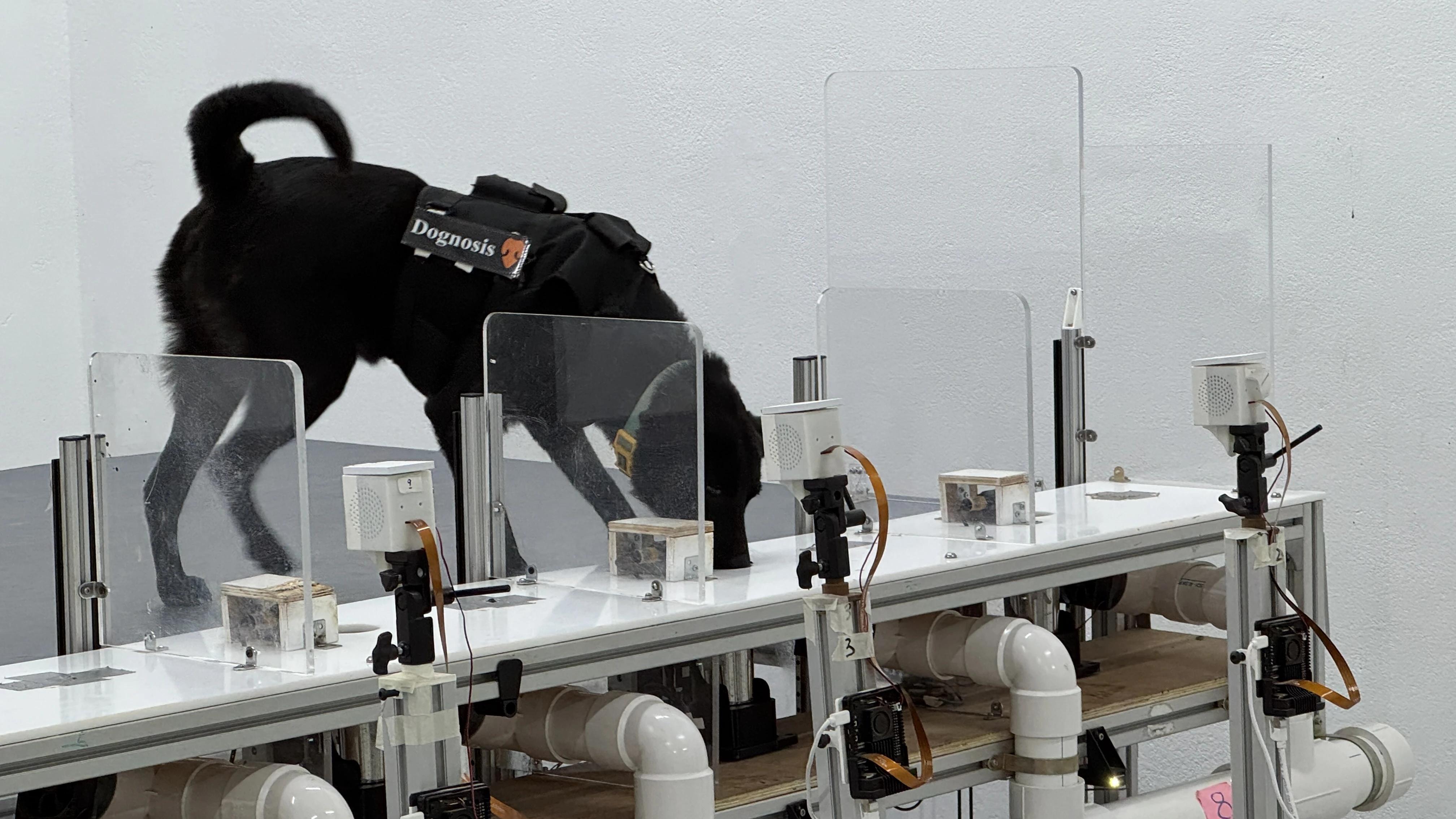
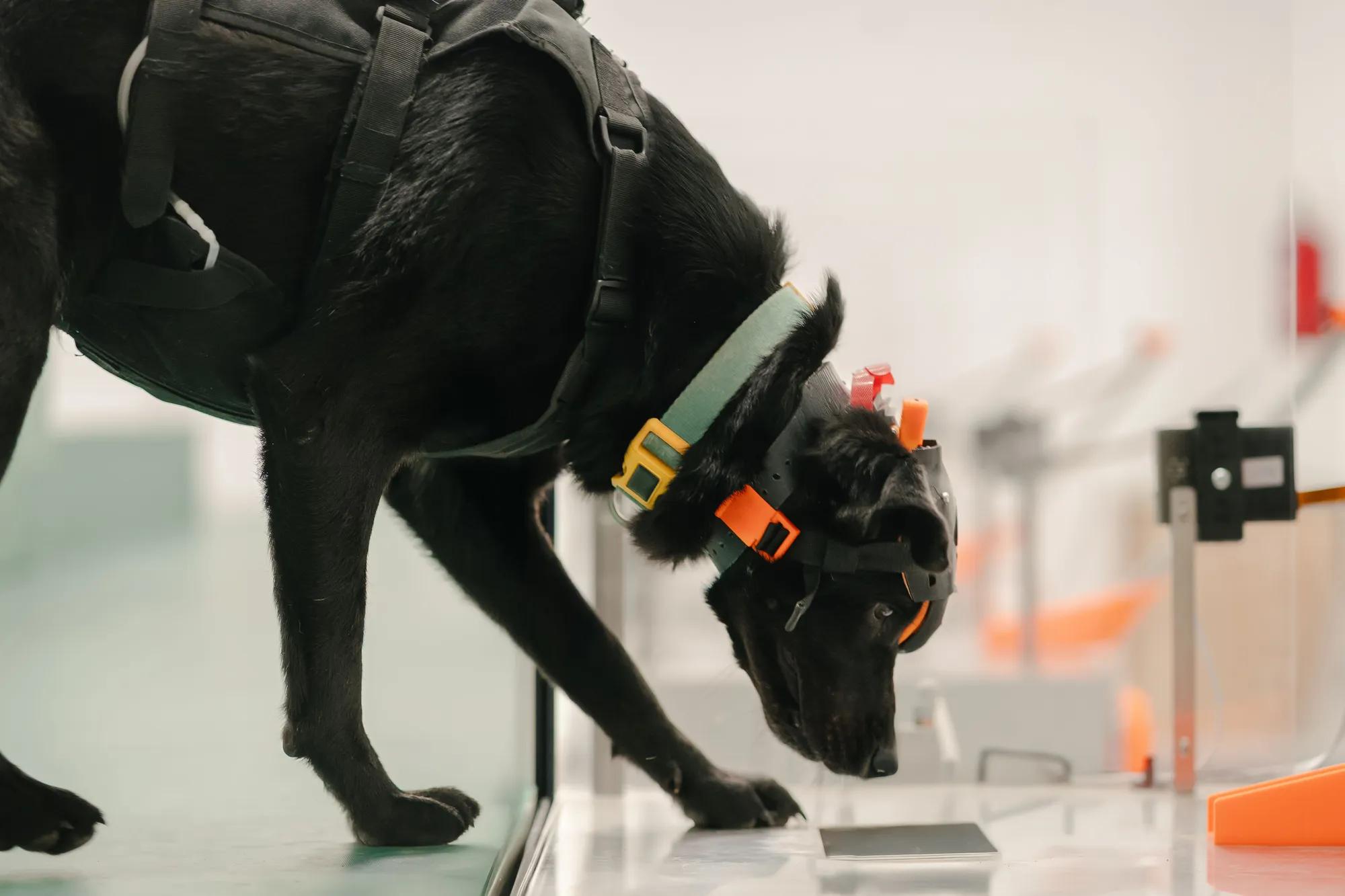
The infrastructure has two named parts, covered in full in How BreathEasy Uses Canine Brain-Computer Interfaces to Detect Cancer. DogSense is the brain-computer interface that reads and records a dog's physiological response as she encounters a sample, the micro-signals in her behaviour that indicate detection. DogOS is the machine learning platform that processes those signals against a reference library of breath profiles, producing a VOC score that captures not just what she noticed, but how confidently, and against what baseline. Together, under the umbrella of Olfaction AI, they give a dog's nose a memory, a standard, and a record, something raw observation alone cannot provide.
The test-taker breathes into a mask for approximately ten minutes, comfortable and non-invasive, requiring nothing more than normal breathing. That's it, from their perspective. The sample is then presented to the dog and the rest of the pack under controlled conditions, where DogSense captures their responses and DogOS turns them into a VOC score. A Registered Medical Practitioner reviews that score, applies clinical judgement, and signs off on the result. Results are not instant, and that's deliberate: the system is built for accuracy over speed, and the review step is a feature, not a delay.
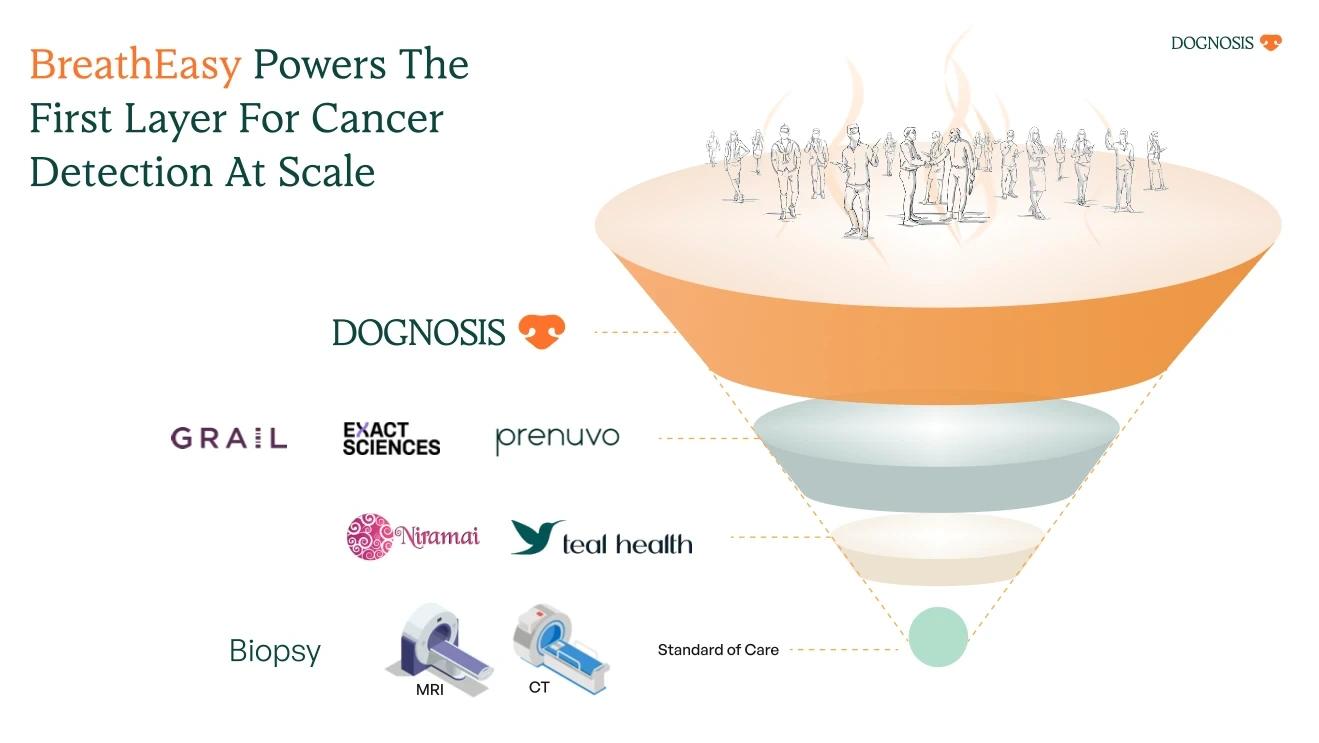
It is worth being clear about what that VOC score is and what it is not. This is a screening result, a signal that says "look further here" or "no flag at this time," not a confirmation of anything. BreathEasy sits at the top of a screening funnel, and it was built to sit there deliberately, following a structure researchers call the CanTest Framework: inexpensive, high-sensitivity triage tests that narrow a population down before more expensive, more invasive testing gets deployed on the smaller group that actually needs it (Walter et al., BMC Cancer, 2019). Narrower, blood-based multi-cancer tests, GRAIL's Galleri is the best-known example, can sit in the middle of that structure. The biopsy, the MRI, the CT scan, sit further down still. BreathEasy's job is to help identify who needs to take those next steps sooner rather than later.
Why Combining Breath Screening With Imaging Beats Imaging Alone
Here is the part that is easy to miss, and worth being precise about, because it is the actual argument for why the funnel exists at all: running imaging on everyone and running imaging on a breath-flagged subset are not the same test, even when the scanner is identical. Imaging's own accuracy does not change between the two. What changes is what a positive scan means, and it changes because of who is being scanned, not how well the scanner works.
Picture two rooms of a hundred people each. In the first, everyone walks in off the street, and maybe one or two actually have early cancer. Scan the whole room, and even a good scanner will flag some healthy people along with the sick ones, because at that low a starting rate, false alarms outnumber real finds by sheer weight of numbers. In the second room, everyone has already been through a breath screen, and the room now holds far more people who are actually sick, because breath screening did its job upstream and filtered out most of the healthy crowd. Scan that second room with the exact same scanner, and a positive result is now far more likely to be real. Nothing about the scanner improved. What changed is who walked into the room, and that change alone raises the positive predictive value, the odds that a positive result is a true one, of the same imaging test.
Recent research bears this out directly. A 2025 study combining a blood-based biomarker test with CT imaging findings for lung nodules found the combined approach reached 90% sensitivity and 95% negative predictive value at 25% disease prevalence in its validation cohort, a level of performance neither test achieves as cleanly alone (Berndt et al., Journal of Liquid Biopsy, 2025). That is the funnel argument in miniature: two tests, staged in sequence, produce a real accuracy gain that comes from the staging itself, not from either test individually getting better. BreathEasy's role in that structure is to do the upstream filtering, at low cost and no procedural burden, so that the imaging and biopsies further down the funnel are working with a population where a positive result actually means something.
This is also the exact trap serious critics of cancer screening have spent years warning about, and it is worth naming directly rather than skating past it. Siddhartha Mukherjee's 2025 essay on early cancer detection lays out the case carefully: screening a low-prevalence population directly produces overdiagnosis and false positives, unnecessary procedures, anxiety, and harm, and the only honest way to judge a screening method is by whether it actually reduces disease-specific deaths, not by how many anomalies it finds (Mukherjee, "The Catch in Catching Cancer Early," The New Yorker, June 2025). He is right to insist on that bar. The funnel is Dognosis's answer to it: BreathEasy is deliberately not positioned as a standalone diagnostic thrown at a low-prevalence population and left to fend for itself. It is the first stage of a structure built to avoid exactly the trap Mukherjee describes, doing the upstream enrichment so that what follows it, imaging, biopsy, a clinician's judgement, is working with better odds than it would have on its own.
What Does an Elevated Breath VOC Score Mean?
When BreathEasy returns an elevated VOC score, it is natural to feel the floor shift. That is worth sitting with. It is also worth knowing exactly what you are holding.
A flag is a direction, not a verdict. The body of literature on breath-based VOC screening has been clear that this category of test exists to triage, not to confirm (Brooks et al., Cancer Investigation, 2015). A positive screen means: this person warrants closer attention from a clinician, with appropriate follow-up. That follow-up might return a different picture entirely. False positives exist. We do not hedge on that. The VOC score that BreathEasy produces is reviewed by a clinician precisely because human judgement, applied to both the score and the person's broader health context, is part of the protocol. The score is an input, not a conclusion.
Equally, a result that shows no flag is not a guarantee. Screening of any kind operates in probabilities, not certainties, and the science on olfaction-based detection continues to develop (Jezierski et al., Journal of Breath Research, 2015), the same body of evidence we break down in What It Took to Make a Dog's Nose Into Medicine. What BreathEasy offers is a meaningful, well-calibrated signal at the start of a process that has many more steps, and the clinician who reviews the score is already the next one.
What Comes Next
None of this works without the dogs at the centre of it. DogSense and DogOS exist to read them more faithfully, not to replace them, that's what people decided when they chose to take a dog's nose seriously.
If you would like to be among the first to take the test when BreathEasy opens in Bengaluru, you can join the waitlist now, quietly, without obligation, just a name and an address and a willingness to breathe.