Why Does BreathEasy Use Breath Instead of Blood?
Blood, urine and tissue all carry real signals. Here's why breath gave our dogs the clearest one, and asked the least of the person taking the test.

There are plenty of places in the body to look for signs of cancer, from blood and urine to stool and tissue, and each of them tells you something real. When we chose where BreathEasy would look, we were weighing two questions at once: which sample gives a trained dog the clearest signal, and which one asks the least of the person taking the test. Breath came out ahead on both, for reasons worth setting out properly.
How Does Cancer Change Your Breath?
When cells turn cancerous, their metabolism changes, and so do the chemical byproducts they give off. Some of those byproducts are volatile organic compounds (VOCs), molecules small and light enough to pass from tissue into the bloodstream and then across the thin walls of the lungs into the air you breathe out (Zhou et al., Advances in Clinical Chemistry, 2024). That makes exhaled breath a readout of what's happening across the whole body. A tumour doesn't have to sit in the lungs to leave a trace there, because the blood carries its chemistry to the one place where gases leave the body with every breath.
Researchers have spent years showing that the mix of VOCs in a cancer patient's breath differs measurably from that of a healthy person, across many cancer types (Einoch Amor et al., European Respiratory Review, 2019). Breath also holds more to read than other samples: the standard reference catalogue of human volatile compounds lists 1,488 distinct VOCs in breath, against 444 in urine and 379 in blood (Drabińska et al., Journal of Breath Research, 2021). For a long time the hard part has been reading that signal reliably, and that's where the dogs come in.
Why Work With Dogs to Read Breath?
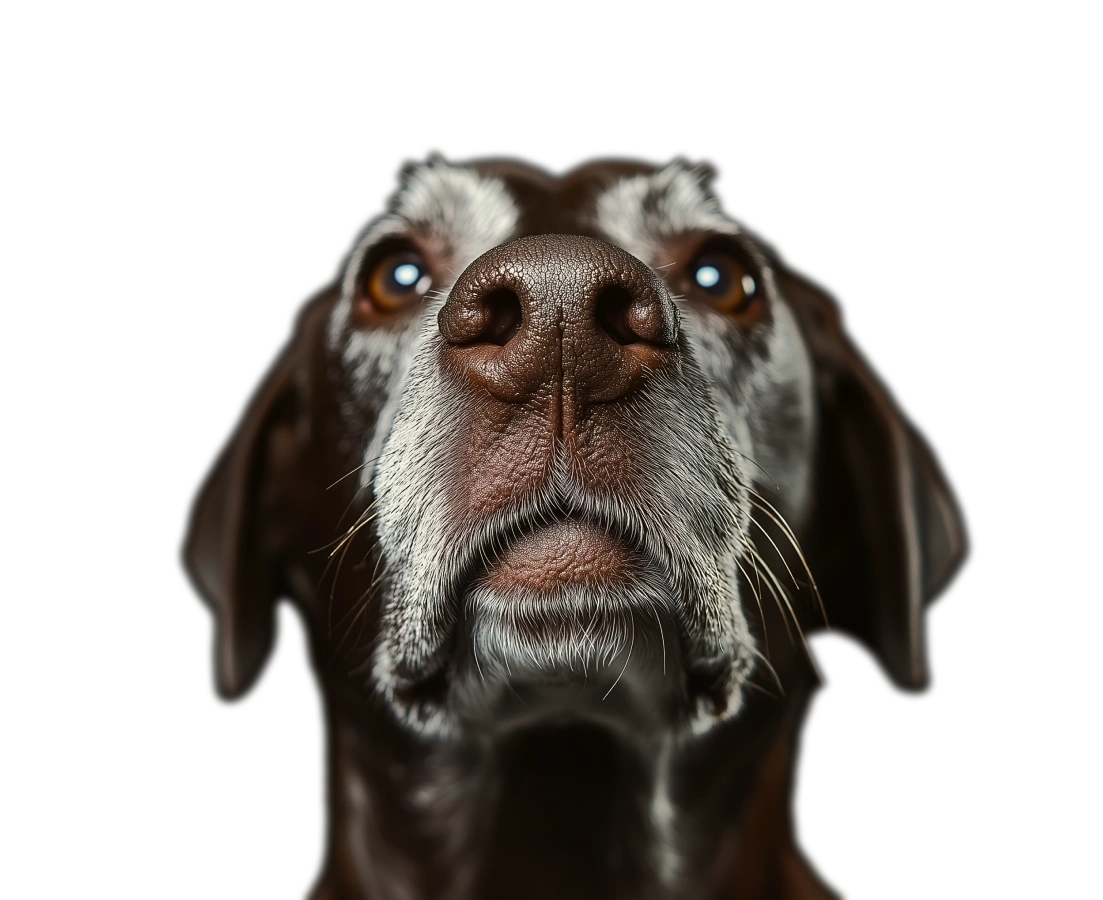
A dog's nose is built for exactly this kind of problem. Dogs carry somewhere between 125 and 300 million olfactory receptors, against roughly 5 to 6 million in humans (Kokocińska-Kusiak et al., Animals, 2021), and trained detection dogs can pick up some odours at concentrations as low as one part per trillion (Angle et al., Frontiers in Veterinary Science, 2016).
The published record on dogs and cancer goes back decades. In one early double-blinded study, trained dogs identified lung cancer from breath samples with a sensitivity of 0.99, meaning they caught 99 in every 100 cancers, and breast cancer with a sensitivity of 0.88 (McCulloch et al., Integrative Cancer Therapies, 2006). A 2022 review found dogs, rodents, insects and even nematodes detecting cancer odours with success rates close to 90% (Gouzerh et al., Biochimica et Biophysica Acta: Reviews on Cancer, 2022).
The results also vary, and that variation matters. In a 2022 study of two dogs detecting lung cancer, performance that looked strong in unblinded tests settled at an accuracy of 68% for one dog and 83% for the other once the tests were double-blinded, so that nobody in the room knew which samples were which (Riedlova et al., Complementary Therapies in Medicine, 2022). A dog's ability to detect the signal has never really been in question. Making that ability consistent from one dog, and one day, to the next is the harder problem, and it starts with training.
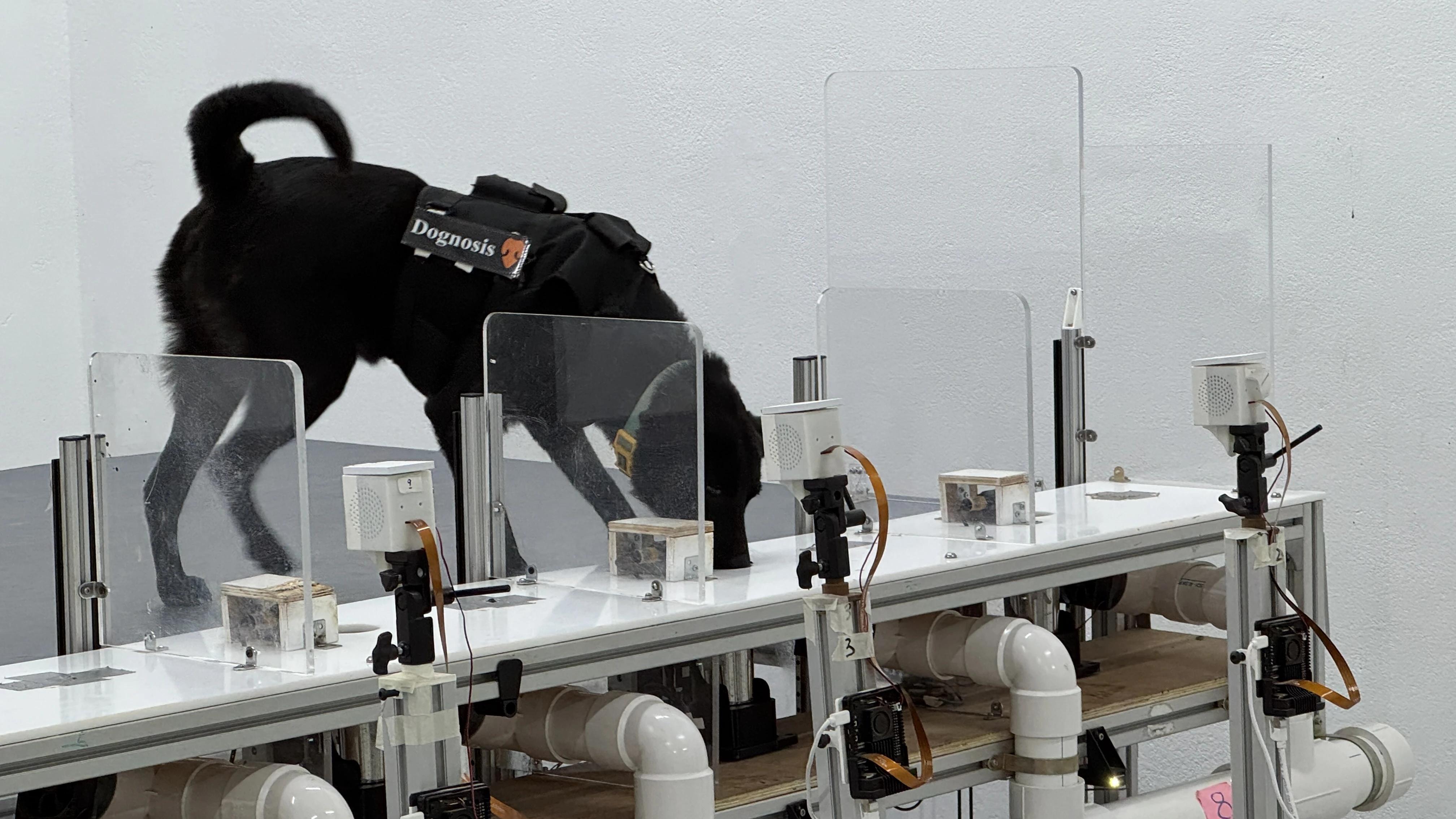
That consistency is what DogSense and DogOS are for. DogSense, a headset fitted to each dog, records what happens in her body as she meets a sample, from brain activity to breathing and heart rate, and DogOS, our suite of machine learning models, interprets those signals alongside each dog's own track record (more on how the two work together). The dog's nose still does the detecting, while the system around it makes each response measurable and repeatable. In our peer-reviewed study in the Journal of Clinical Oncology, that combination achieved 90.8% sensitivity and 91.3% specificity (how many people without cancer it correctly cleared) in multicancer detection from breath samples of 3,275 participants.
Why Not Blood or Urine?
We looked closely at both. Dogs can detect prostate cancer from urine remarkably well, with a 2023 meta-analysis pooling a sensitivity of 0.95 and a specificity of 0.92 across five studies (Warli et al., World Journal of Oncology, 2023), and blood has a large research literature of its own. In the end, the deciding factor was what each sample asks of the person giving it.
A blood draw needs a needle and someone trained to use it. BreathEasy asks you to breathe normally into a mask for about ten minutes, and that's all. The mask is then sealed and sent to our lab, where the dogs assess it later, so the logistics still exist, and they're ours to handle.
That ease matters more than it might seem. A test only helps the people who actually take it, and a smaller ask makes that more likely, which counts for a great deal when the aim is to look for cancer before symptoms appear. It's also why BreathEasy sits at the start of the care pathway, alongside routine blood work and annual check-ups, so that scans and other tests can go to the smaller group of people who need them (why that order matters).
What Does an Elevated Breath VOC Score Mean?
Every BreathEasy report is reviewed by a clinician, who also talks you through it. If your Breath VOC score is elevated, your doctor may recommend further evaluation, using the imaging, biopsy and pathology that standard care already provides. An elevated score is a prompt to look more closely, and some people who receive one will turn out not to have cancer, because every test of this kind produces false positives. What matters is a calm, clear path to follow-up, and that's how the process is designed.
Which Cancers Can Be Detected in Breath?
Breath research now spans many cancer types, including colorectal (Di Lena et al., Colorectal Disease, 2016), gastric (Zhang et al., Journal of Breath Research, 2021) and breast cancer (Leemans et al., Biomarker Insights, 2022), and it reaches beyond cancer to conditions such as liver cirrhosis (Ferrandino et al., Journal of Clinical and Translational Hepatology, 2023). The studies don't all agree, and reviews note that differences in how samples are collected and analysed still make results hard to compare (Leemans et al., 2022). Taken together, though, they point the same way: breath carries a readout of the whole body's metabolism, which is what you'd want from a test meant to look across many cancers at once.
The biology, the dogs and the practicalities all led us to the same sample. BreathEasy is planned to launch in Bengaluru in early 2027, and if you'd like to be among the first to take it, join the waitlist.