Meet DogOS
How our software combines several dogs' responses into one Breath VOC score, and why the dogs still come first.

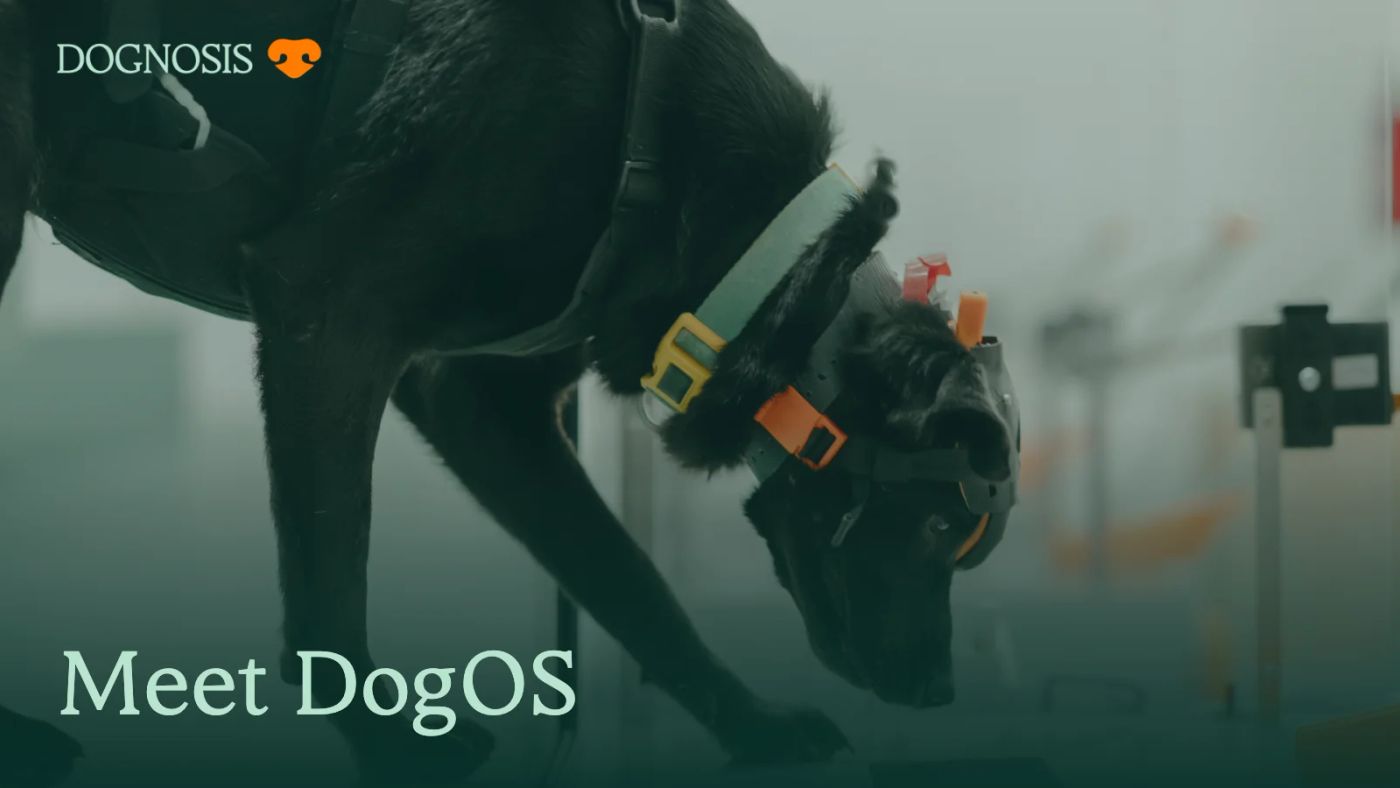
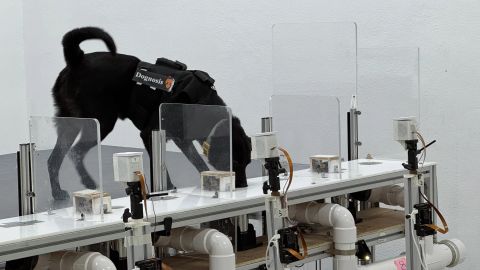
By the time a mask reaches our lab, the person who breathed into it is usually somewhere else, at home or in another city. The dogs never meet them. All they get is the mask, and every sample is sniffed by at least three of them, because one dog's opinion isn't enough to go on. DogOS is what turns those opinions into something a doctor can use.
What Do Dogs Smell in Breath?
Every cell gives off chemical byproducts as it burns fuel, divides and signals to its neighbours. Cancer cells run those processes differently, and some of what they release is volatile organic compounds (VOCs), small molecules that pass into the blood and leave the body in breath (Haick et al., Chemical Society Reviews, 2014). We go into that chemistry in Every Disease Has a Scent. In lung cancer, for one, the mix of VOCs in a person's breath differs from that of someone without the disease (Horváth et al., European Respiratory Journal, 2009).
Dogs are very good at picking that signal up. The dog genome holds about 1,100 olfactory receptor genes, roughly four in five of them intact (Quignon et al., Genome Biology, 2005), a functional set considerably larger than ours (Olender et al., Genomics, 2004), but what a dog can't do is explain what she smelled, and individual dogs differ. That gap is what DogOS is for.
How Does DogOS Work?
DogOS is the machine learning system behind CancerWatch by Dognosis, and it combines the responses of several dogs into one Breath VOC score. Alongside it, DogSense records the dogs' brain activity, heart rate, breathing and movement while they sniff, which helps us train them and understand their responses in more depth.
It starts from what the person's health record suggests, meaning their age, sex, tobacco use, family history and symptoms, before any dog has sniffed. Then it listens to the dogs: each dog's response at the port shifts that starting estimate, and how far it shifts depends on that dog's own track record, so a dog who has been right more often counts for more. Updating an estimate as evidence arrives is called Bayesian analysis, and at the end the Breath VOC score is reported as Baseline, Medium or Elevated.
We published the method in the Journal of Clinical Oncology. It separated people with and without cancer better than a simple majority vote across the dogs, with an AUC (a measure where 1.0 would be a perfect separation) of 0.962 against 0.932, and far better than the health-record estimate alone, at 0.832, and which dog happened to be sniffing mattered very little, since under 2% of the variation in responses came down to the individual dog (Kulgod et al., Journal of Clinical Oncology, 2026).
In those results the dogs carry most of the signal and the health record adds a smaller but real improvement, which is why DogOS can't stand in for them: it only has something to weigh because they're detecting. Electronic noses are an active area of research, and canine olfaction and gas chromatography-mass spectrometry are generally seen as complementary tools (Maidodou et al., Frontiers in Chemistry, 2023), so what DogOS adds is a standard form for the dogs' detection.
What Does a Breath VOC Score Mean?
A doctor reviews every Breath VOC score and talks it through with the test-taker, and based on your Breath VOC score, your doctor may recommend further evaluation, such as imaging or a biopsy. A Baseline score doesn't guarantee that you're clear, and an Elevated one doesn't mean you have cancer. CancerWatch sits at the start of the care pathway, next to routine blood work and the yearly check-up, and it replaces none of the tests that come after it.
Some people with a Medium or Elevated score will go through follow-up and find nothing, as happens with any test of this kind: in the US National Lung Screening Trial, 96.4% of positive CT scans turned out to be false alarms (National Lung Screening Trial Research Team, New England Journal of Medicine, 2011). That can be stressful, in practical ways and emotional ones, and we take it seriously.
What Is It Like to Take the Test?
Quieter than you'd expect, and it ends with a conversation with a doctor. You breathe normally into a mask for about ten minutes, with no needle, no dye and no loud machine. What follows happens at the lab, out of sight: the dogs sniff your sample, DogOS combines what they tell us, and a doctor goes through your Breath VOC score with you.
CancerWatch is planned to launch in Bengaluru in early 2027, and you can join the waitlist to hear when it's your turn.
CancerWatch is not a diagnostic test. It does not diagnose, predict, prevent, cure, treat, mitigate, or monitor cancer or any other disease or disorder.