What Makes a Good Test for Catching Cancer Recurrence?
Finishing treatment rarely feels like a clean ending. Here's what doctors look for in any cancer test, and what that means for catching a recurrence.

For many people who have been through cancer, finishing treatment brings a new kind of waiting. In one large colorectal cancer trial, follow-up meant a blood test every three months and a CT scan every six months for the first two years (Primrose et al., JAMA, 2014), and between those appointments sits the question of whether the cancer has come back. Working out what kind of test could help with that question starts with the principles doctors use to judge any cancer test.
What Makes a Cancer Test Worth Taking?
In 1968, James Wilson and Gunnar Jungner set out ten principles for judging screening programmes for the World Health Organization, and they still shape how new tests are assessed (Wilson & Jungner, WHO, 1968). At their core sits a simple demand: finding a disease earlier has to change what happens to the person. A test that reliably detects something is only useful if that detection leads to better outcomes.
Two measures dominate that judgement. Sensitivity is the share of people with cancer that a test correctly flags, and specificity is the share of people without cancer that it correctly clears. The two usually pull against each other, so a test tuned to miss as few cancers as possible will also raise more false alarms (Trevethan, Frontiers in Public Health, 2017). In the US National Lung Screening Trial, low-dose CT scans cut deaths from lung cancer by 20%, but 24.2% of scans came back positive, and 96.4% of those positives turned out to be false alarms (National Lung Screening Trial Research Team, New England Journal of Medicine, 2011).
False alarms carry a real cost. Three years after being told they didn't have breast cancer, women who'd had a false-positive mammogram still reported more psychological distress than women whose mammograms were normal (Brodersen & Siersma, Annals of Family Medicine, 2013). Finding too much can cause harm as well: when South Korea took up widespread thyroid ultrasound screening, diagnoses rose sharply while deaths from thyroid cancer barely changed, because many of the tumours found would never have caused harm (Ahn, Kim & Welch, New England Journal of Medicine, 2014).
A test also has to be one that people will actually take. In one German study, 106 of the 109 people who turned down a colonoscopy accepted a less invasive test instead (Adler et al., BMC Gastroenterology, 2014). However well a test performs, it does nothing for the people who avoid it.
Why Who You Test Changes What a Positive Means
Who a test is used on matters just as much, and it gets far less attention. How often a positive turns out to be right depends heavily on how common the disease is in the people being tested (Trevethan, 2017).
Take a test that performs the way BreathEasy did in our published study, catching about 91 in every 100 cancers and correctly clearing about 91 in every 100 people without cancer. Used across a general population where roughly 1 in 100 people has an undetected cancer, only about 1 in 10 elevated scores would turn out to be cancer, because a small share of false alarms is spread across a very large number of healthy people. Used in a group where 1 in 5 people has cancer, the same test would be right about 7 times in 10. The test stays exactly the same in both cases, and the difference comes entirely from who is taking it. It's the same logic behind why putting tests in the right order makes each one more accurate.
Why Recurrence Monitoring Is Different
People who have finished cancer treatment are one of the clearest examples of a higher-risk group. Among women with the most common type of early breast cancer who were cancer-free after five years of hormone therapy, the risk of the cancer returning elsewhere in the body over the next 15 years ranged from 10% to 41%, depending on the size and spread of the original tumour (Pan et al., New England Journal of Medicine, 2017). In the colorectal trial above, 16.6% of participants had a recurrence within about four and a half years (Primrose et al., 2014).
That shifts every trade-off described above. A false alarm still matters, but it's more likely to be outweighed by the recurrences a test helps find, and the people taking it are already under a doctor's care with a follow-up plan in place. Catching a recurrence earlier can also open up treatment options: in the same trial, regular CT scans or blood tests roughly tripled the share of people whose recurrence was found in time for surgery aimed at a cure, from 2.3% with minimal follow-up to between 6.6% and 8%, although any effect on overall survival was likely to be small (Primrose et al., 2014).
The waiting has a cost of its own. Fear of recurrence ranks among the concerns cancer survivors raise most often, and it tends to hold steady for years after treatment (Simard et al., Journal of Cancer Survivorship, 2013). The follow-up scans meant to catch a recurrence add to that weight: in one study of people with recurrent or advanced lung cancer, 83% reported distress linked to their scans, a burden common enough to have earned a name of its own, scanxiety (Bauml et al., Lung Cancer, 2016). For someone keeping watch over many years, a test that's easy to take and easy to repeat matters as much as raw accuracy.
Where Does BreathEasy Fit?
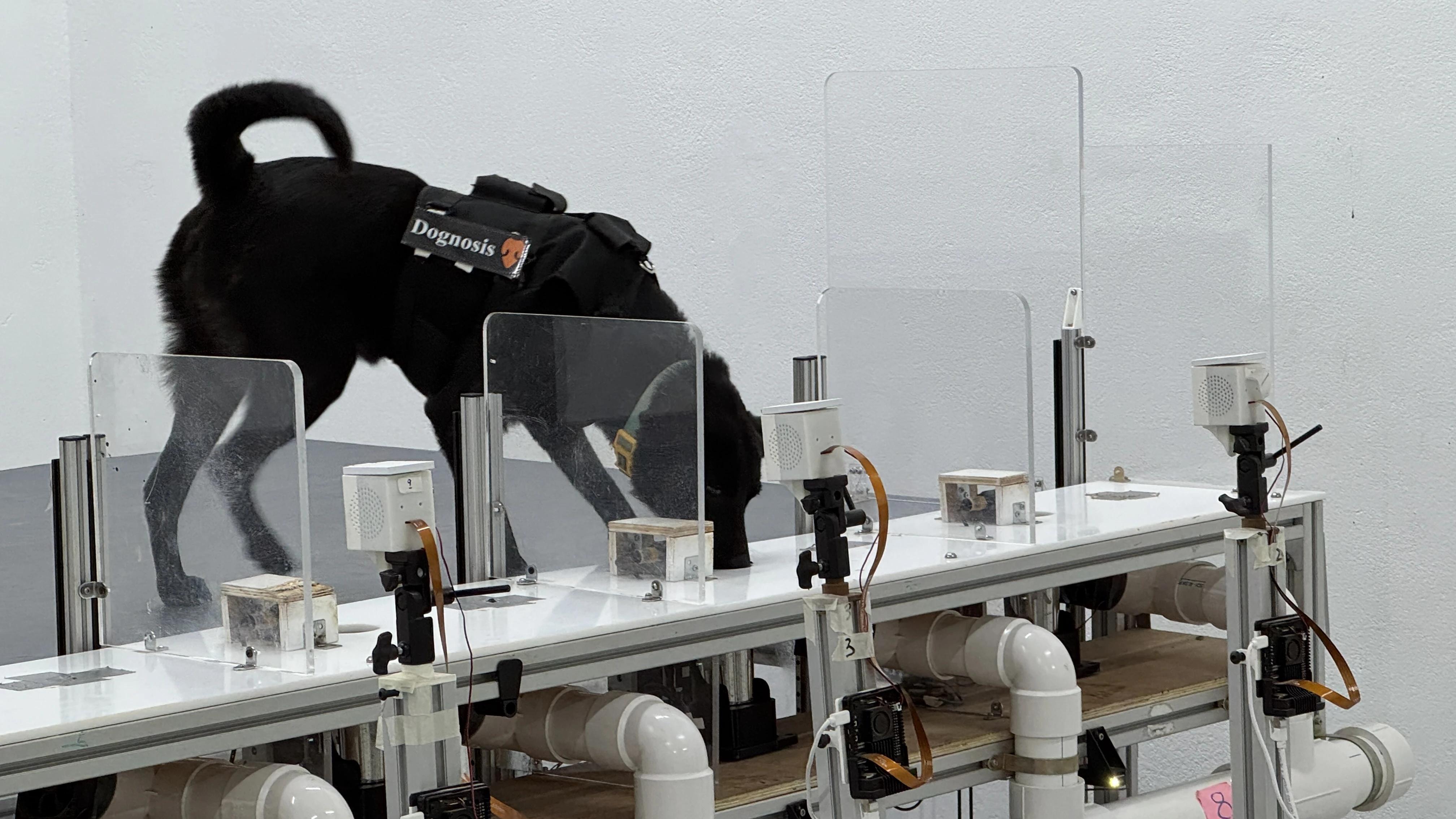
BreathEasy asks you to breathe normally into a mask for about ten minutes. Trained dogs analyse the volatile organic compounds in that breath, with our DogSense and DogOS technology recording and combining their responses into a Breath VOC score, which a clinician reviews and talks you through. In our peer-reviewed study in the Journal of Clinical Oncology, 3,275 people were enrolled, with 1,773 used to train the model and 1,502 to test it. In the testing group, BreathEasy showed 90.8% sensitivity and 91.3% specificity in multicancer detection from breath samples. BreathEasy is built to sit alongside the follow-up scans and tests doctors already rely on, helping your doctor understand your cancer risk and decide when to look more closely.
A good test depends on more than its numbers, including who it's for, what it asks of them, and what happens after it flags something. For people living with the possibility of recurrence, those answers point towards a test that's easy to take and easy to repeat. If you'd like to hear about BreathEasy as it launches, join the waitlist.