What Does It Mean When Doctors Say a Cancer Was "Caught Too Late"?
Sooner than what, and what happened in the meantime? How staging, silent early symptoms and delays in care shape the odds, and where early detection fits.

Most of us have heard some version of it. A relative's diagnosis, a news story about someone famous, a TV doctor lowering their voice: "We wish we'd caught it sooner." It gets said so often that we rarely stop to ask what it actually means. Sooner than what, and what happened in the meantime?
How Cancer Staging Works
What makes a cancer malignant is that it can push into the tissue around it and spread to other parts of the body, and staging is a way of saying how far it has got. At stage 0, the abnormal cells haven't yet moved into the tissue around them. Stages I to III cover cancers that have grown bigger or reached nearby tissue and lymph nodes, and by stage IV the cancer has spread to other organs (National Cancer Institute; Amin et al., AJCC Cancer Staging Manual, 2017).
The stage at diagnosis shapes almost everything that follows, including survival. For some common cancers, more than 90% of people are alive five years after being diagnosed with localised disease, but once the cancer has reached distant organs, that can drop to 10% or less (American Cancer Society, Cancer Facts & Figures 2025). With lung cancer, 65.5% of people survive five years when it's found before it has spread beyond the lung (SEER, Cancer Stat Facts: Lung and Bronchus Cancer), and far fewer do once it has.
Why Cancer Often Has No Early Warning Signs
Most cancers inside the body don't hurt when they're small. A tumour in a lung, an ovary or the pancreas usually isn't pressing on anything that would cause pain, so it can grow for a long time without anyone knowing, and by the time symptoms do show up, it has often moved on to a later stage. In a study of almost 8,000 people with cancer in England, pain in the chest or back was consistently linked to cancers that had already reached stage IV (Koo et al., Lancet Oncology, 2020).
Ovarian cancer is one of the hardest examples. Only about 15% of cases are found while the cancer is still confined to the ovary, mostly because the early signs are vague and easy to put down to something else, both for the woman herself and for the first doctor she sees. Caught at that stage, around 92% of women are alive five years later. Once it has spread to distant organs, that drops to about 30% (American Cancer Society, Survival Rates for Ovarian Cancer).
Why Cancer Diagnosis Gets Delayed
Researchers who study delays split them into two parts (Weller et al., British Journal of Cancer, 2012):
- The patient interval, from first noticing something wrong to seeing a doctor.
- The diagnostic interval, from that first visit to a confirmed diagnosis, which takes in the wait for a referral and the wait to see a specialist.
Around the world, these waits tend to be longest for gastrointestinal, genitourinary and blood cancers, and they're longer in countries without policies for early diagnosis (Petrova et al., PLoS Medicine, 2022). Studies from India show what that looks like day to day. At one hospital in Kerala, people with lung cancer waited around eight weeks after their first breathing symptoms before they saw a doctor, then about five weeks more to be referred to a specialist, partly because many of them were first treated for tuberculosis (Yohannan et al., South Asian Journal of Cancer, 2023). In another Kerala study, more than half of the people with oral cancer waited over 90 days before getting care, and the longer they waited, the later their cancer tended to be diagnosed (Philip & Kannan, Asian Pacific Journal of Cancer Prevention, 2021). A smaller study of 20 people with gastrointestinal cancer found an average of eight months between first symptoms and treatment, and more than half of that went by before they'd been to a hospital at all (Sathoo et al., Journal of Family Medicine and Primary Care, 2021).
Part of the reason is that symptoms are easy to read as something else. A cough that won't go away and a shadow on a chest X-ray look a lot like tuberculosis, which is far more common in India than lung cancer (Yohannan et al., 2023). At AIIMS in New Delhi, 14 of 70 people with lung cancer had first been treated for TB, for an average of four and a half months, before anyone found the cancer (Singh et al., Asian Pacific Journal of Cancer Prevention, 2009). Cost and distance play their part too. At Tata Memorial Hospital in Mumbai, people with stomach and pancreatic cancer travelled an average of 1,475 km for treatment, and 39.3% had to borrow money or sell something to pay for it (Pandey et al., Journal of Cancer Policy, 2025).
Some delays have nothing to do with access. In a recent study of women with breast cancer, most hadn't suspected cancer when their symptoms started. Of those who did, many held off because they were frightened of what they'd hear, and others because of childcare, work or the cost. More than two-thirds were in significant distress (Ktari et al., European Psychiatry, 2025), and the waiting makes it worse, since the longer people wait for a diagnosis, the more distressed they tend to be (Risberg et al., Anticancer Research, 1996). A lot of the time, the people who put off seeing a doctor are the ones most afraid of what they'll hear.
Can Dogs Detect Cancer Before Symptoms Appear?
A tumour is chemically busy long before anyone notices it. As it grows, it gives off volatile organic compounds (VOCs), small molecules that get into the blood and leave the body in breath (Haick et al., Chemical Society Reviews, 2014; Gao et al., Cancer Pathogenesis and Therapy, 2025). That's the idea behind breath-based detection. The chemical trace is there well before the symptoms, and the hard part is reading it reliably.
Trained dogs turn out to be very good at it. Across many studies, they've picked out cancer samples from controls by smell alone, in prostate, cervical, breast and bone cancers (Bauër et al., Integrative Cancer Therapies, 2022). Two dogs trained on urine samples caught prostate cancer with a mean sensitivity of 99% and specificity of 98%, across 362 confirmed cases and 540 controls (Taverna et al., Journal of Urology, 2015). Another, trained on cervical cancer and precancerous changes, got all 83 of its double-blind test runs right (Yamamoto et al., Cancers, 2020). Not all of the research is that strong, and a 2022 review of 62 studies said so, though it still found the approach was real and worth pursuing (Bauër et al., 2022).
The problem, for decades, has been turning that into something a doctor can rely on day after day, without needing the same dog in every clinic.
How BreathEasy Turns Canine Detection Into a Cancer Test
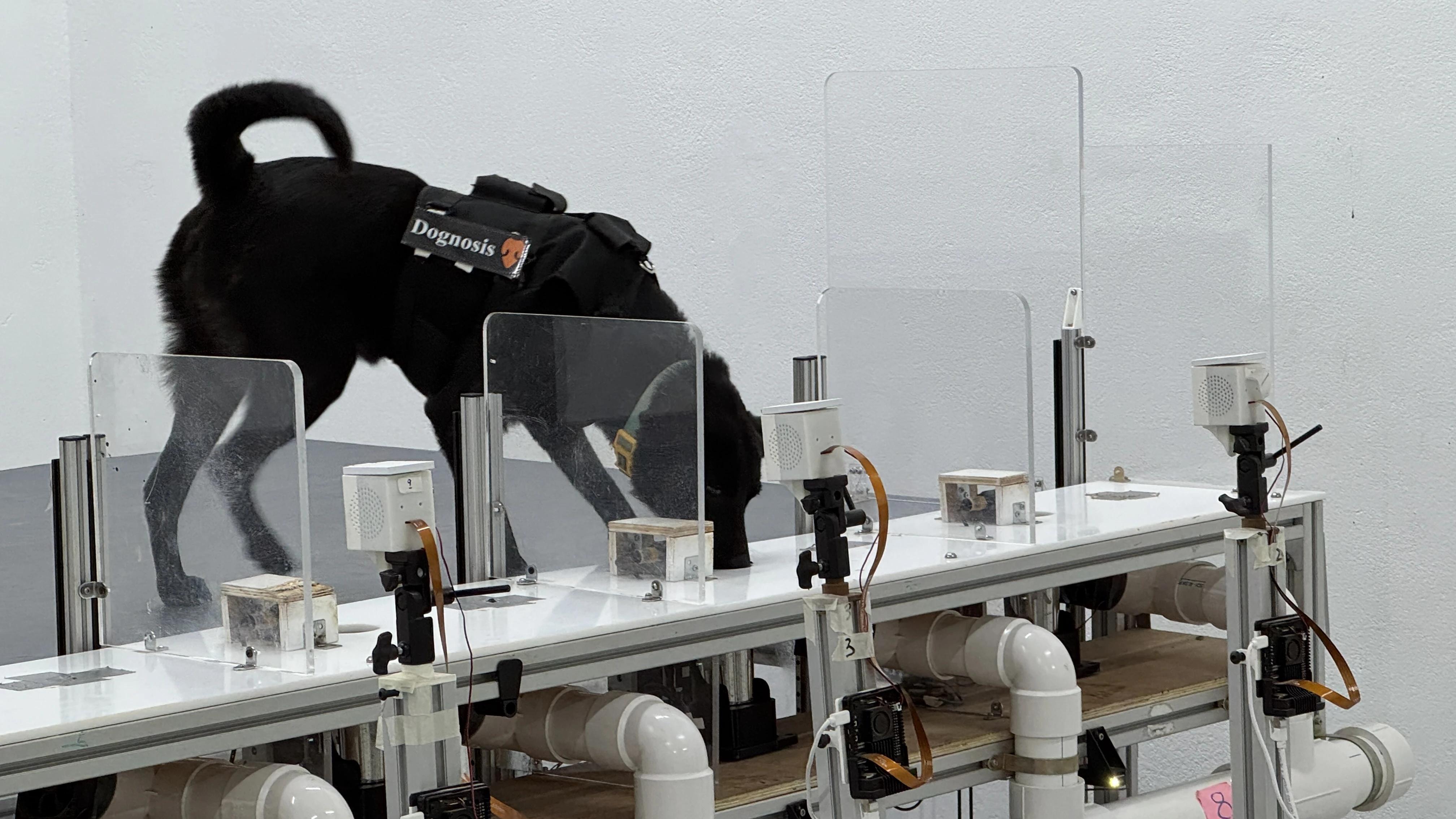
That's where Chloe, Billy, Whiskey and the rest of our dogs come in. Each of them trains for months before their responses are reliable enough to build a clinical test around. You breathe into a mask for about ten minutes, the mask is sent to our lab, and the dogs sniff it there. DogSense, the brain-computer interface our dogs wear, records their brain activity and breathing as they sniff, and DogOS, our machine learning platform, combines the dogs' responses into a Breath VOC score that a clinician then goes through with you.
In our study published in the Journal of Clinical Oncology, which looked at multicancer detection in breath samples, 3,275 people were enrolled, with 1,773 used to train the model and 1,502 to test it. In the testing group, BreathEasy had 90.8% sensitivity and 91.3% specificity, and picked up 90.3% of stage I cancers (Kulgod et al., Journal of Clinical Oncology, 2026). Those numbers come from a study setting, and our next phase of research will show how BreathEasy does in the wider population.
BreathEasy sits at the start of the care pathway, next to routine blood tests and the yearly check-up, and helps your doctor understand your cancer risk (why that order matters). The biopsy, the scans and the oncologist are all still there; what changes is how early someone gets to them.
Remember the patient interval, the wait between noticing something wrong and seeing a doctor. It's often the longest part of the delay (Yohannan et al., 2023), and it only starts once there's a symptom to notice. BreathEasy is meant to be taken before any symptoms appear, so it can get someone to a doctor before that wait has even begun.
Why Earlier Screening Changes the Outcome
"Too late" is really about timing, about how far a cancer had got by the time it reached a doctor. The same cancer found eighteen months earlier is a different conversation, with more options and better odds.
So the looking has to happen before symptoms do, the same way plenty of people already keep an eye on their blood pressure or cholesterol without waiting to feel ill. If you haven't had any cancer screening in the past year, it's worth thinking about, for your own sake or for someone you love. For people who have already finished treatment, the question shifts to what makes a good test for catching a recurrence.
BreathEasy is planned to launch in Bengaluru in early 2027. If you'd like to be one of the first to take it, join the waitlist.