How Do Dogs Learn to Detect Cancer?
A dog's indication for a breath sample looks simple. It's the product of months of training, and a nose built on hardware humans have never replicated

Why Do Dogs Have Such a Powerful Sense of Smell?
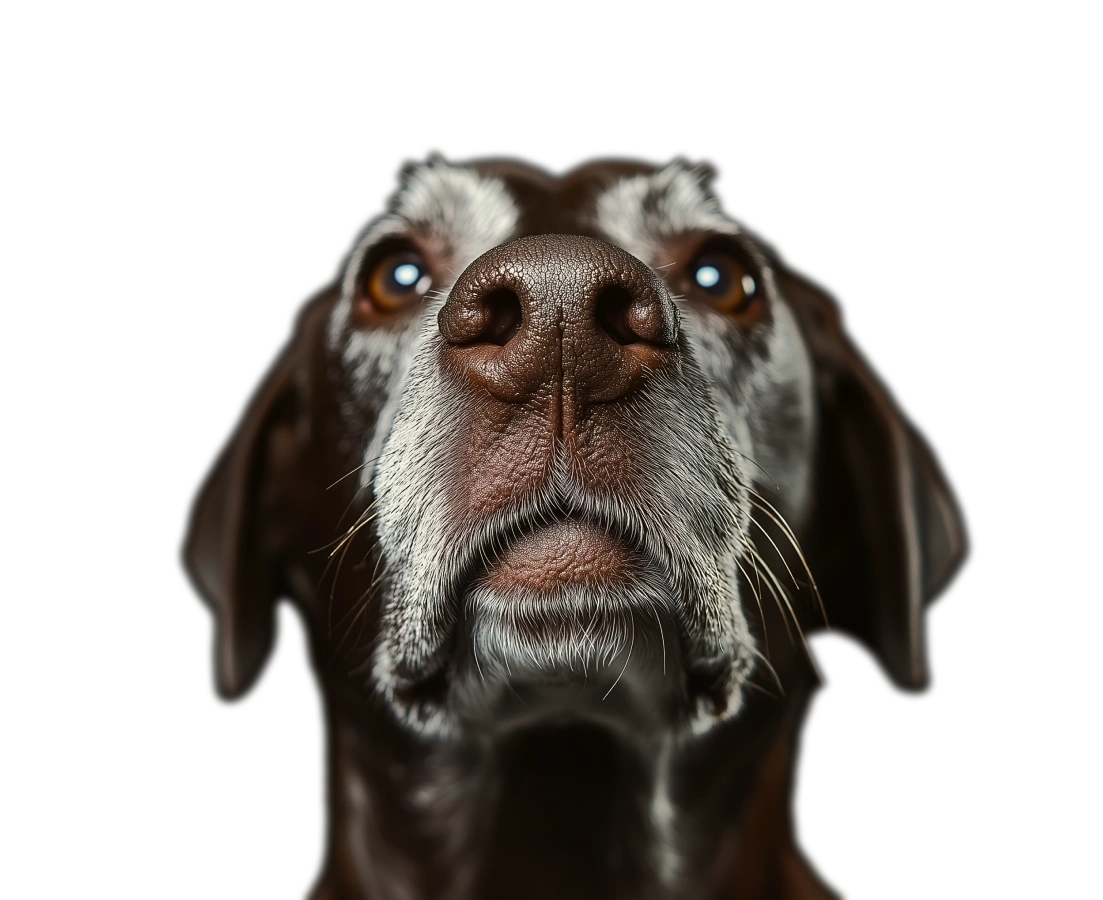
A dog's olfactory system is built at a scale that has no human equivalent. Comparative genomic studies place the number of functional olfactory receptor genes in dogs somewhere in the high hundreds to low thousands, while placing humans, like other primates, well under 400 (Niimura & Nei, PLOS One, 2007). Each of those genes encodes a distinct receptor protein, each tuned to recognise a different class of airborne molecule. The nose that results is structurally more complex than ours, capable of parsing a scent as an intricate chord of dozens of chemical components rather than a single note.
Cancer changes the body's chemistry. Tumour metabolism produces and alters the release of volatile organic compounds, trace molecules that travel through the bloodstream, reach the lungs, and appear in exhaled breath (Mazzone, Journal of Thoracic Oncology, 2008). These compounds form a signature, one that differs from the baseline breath of a healthy body in ways measurable by mass spectrometry, and perceptible to a trained detection dog, a signature we go into in more depth in Every Disease Has a Scent. Whether a dog can smell that difference was never really in question. Teaching a dog to tell you, reliably, when it does, is the harder problem.
How Dog Training and Human Partnership Made This Possible
Dogs did not arrive at this capability by accident, and neither did we arrive at our ability to develop it in them. The relationship between humans and dogs is, by current genetic and archaeological evidence, at least fifteen thousand years old, with its own long history in medical detection specifically. From the beginning, what humans selectively valued in dogs was not just companionship but utility, the capacity to extend human perception into terrain and sensory registers we could not access alone.
Operant conditioning, the formal science that now underlies detection training, gave a name to something humans had been doing empirically for centuries (Jendrny et al., BMC Infectious Diseases, 2021). The core principle is that behaviour followed by a rewarding consequence becomes more likely to recur. A 2019 review of the behavioural and cognitive factors behind scent detection dog success found that reinforcement schedules, training regimes, and the handler-dog relationship all measurably affect how reliably a dog's response holds up under real-world conditions (Troisi et al., Comparative Cognition & Behavior Reviews, 2019).
How Are Dogs Trained to Detect Cancer?
The answer, at its core, is operant conditioning: a process that rewards a dog for offering a specific behaviour in response to a specific stimulus, and gradually shapes that behaviour until it is consistent, reproducible, and meaningful as data. What matters is that the behaviour is distinctive, calm, and voluntary, a deliberate choice the dog makes because the chemistry it is reading matches the chemistry it has learnt to flag.
Training begins with the dog learning to associate a target odour with a reward, typically food or play, delivered with precision and consistency. Over many sessions, that association becomes robust enough that the dog begins actively searching for the odour rather than waiting for it, because finding it is itself rewarding.
Generalisation is the real difficulty, and what separates clinical detection from recreational nose-games. A single cancer patient's breath contains the target VOC signature, but the exact concentrations and accompanying compounds vary between individuals, and shift depending on diet, hydration, medications, and disease stage and type. A dog trained across a wide and well-curated sample set learns to read deeper into the chemical signature rather than the surface-level smell of one particular sample.
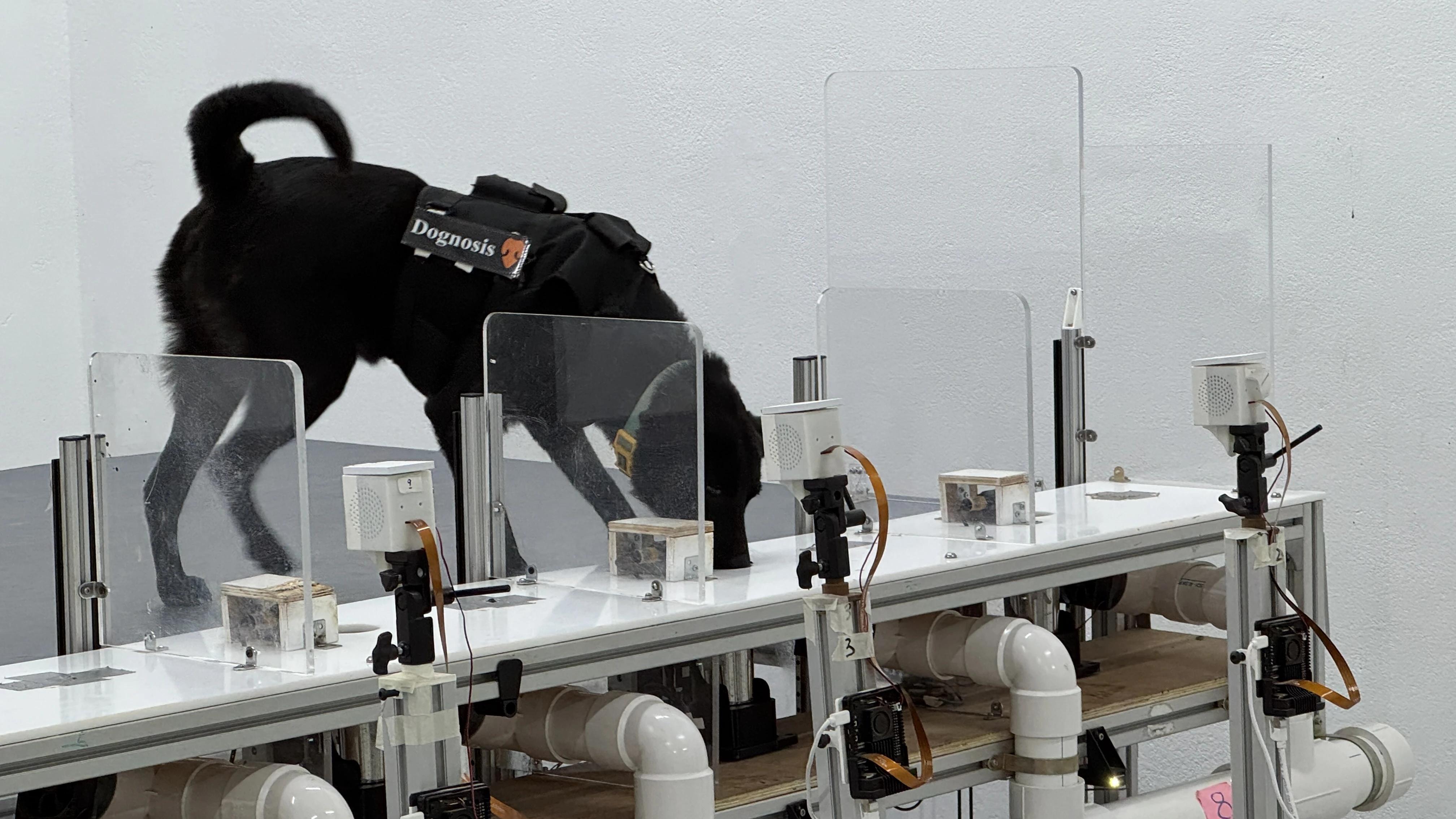
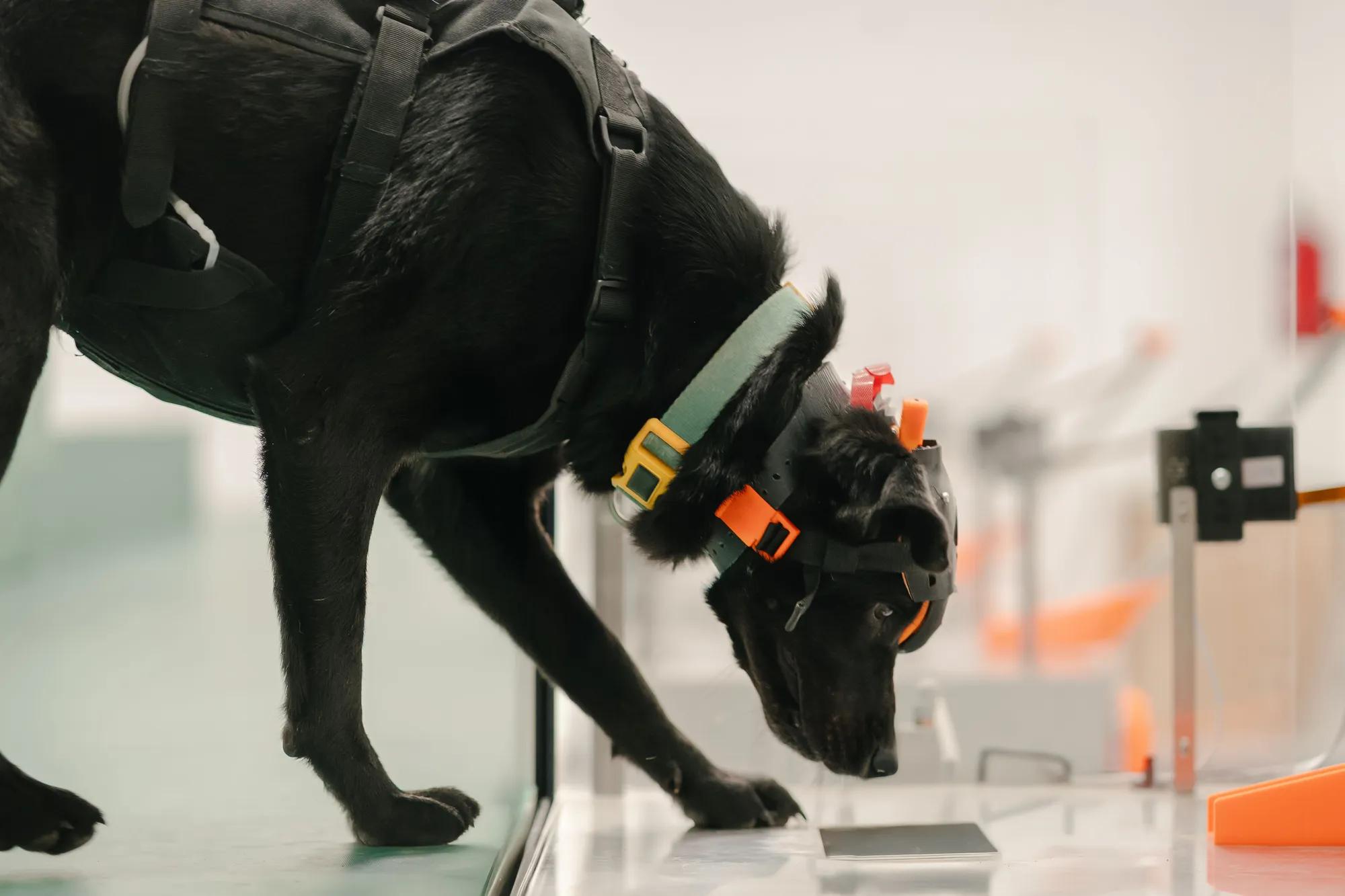
The breath that a test-taker breathes into a collection mask is where months of training become a data point. The dog's nose is answering a narrower, more tractable question than "is this person unwell?" It's asking: does this breath carry the pattern I know? That answer becomes the raw signal that DogSense captures and DogOS translates into a VOC score, which a clinician then reviews before any result reaches the test-taker.
Can a Detection Dog Ever Be Wrong?
A dog is not infallible, and no detection system is. False positives occur, and when they do, they matter. A positive VOC score from BreathEasy does not mean a test-taker has cancer, it means the signal warrants further investigation through standard confirmatory tests. That is exactly what a screening tool at the top of the screening funnel is for: narrowing the field, raising a flag, and handing the question to methods equipped to answer it definitively.
Training aims for consistency across different dogs, sample populations, and disease presentations, and ongoing research continues to refine how well that consistency holds up (Bauër et al., Integrative Cancer Therapies, 2022).
How Dognosis Trains Its Detection Dogs
At Dognosis, the dogs we work with are trained to the standards the published science continues to refine. Sample diversity, handler consistency, ongoing calibration, each element of the training protocol reflects what the research has established matters most. Each dog brings a distinct training history, a particular response style, and a level of confidence under novel conditions built session by session over months alongside a handler who knows them.
DogSense reads and records each dog's response with precision, and DogOS interprets that response against a reference model built from a growing body of validated samples. In a Phase 2 study across six hospitals in Karnataka, that combination of trained dogs and technology achieved 90.8% sensitivity, 91.3% specificity, and an AUC of 0.962, a result we break down in full here, a number that starts with a dog's nose and ends as something a clinician can act on. The technology listens. The dog speaks first.
BreathEasy is targeting a commercial launch in early 2027, starting in Bengaluru. If you want to be first in line when it reaches your city, join the waitlist.