Meet SniffSpace
How our automated platform runs up to 72 samples a session and keeps every sniff traceable.

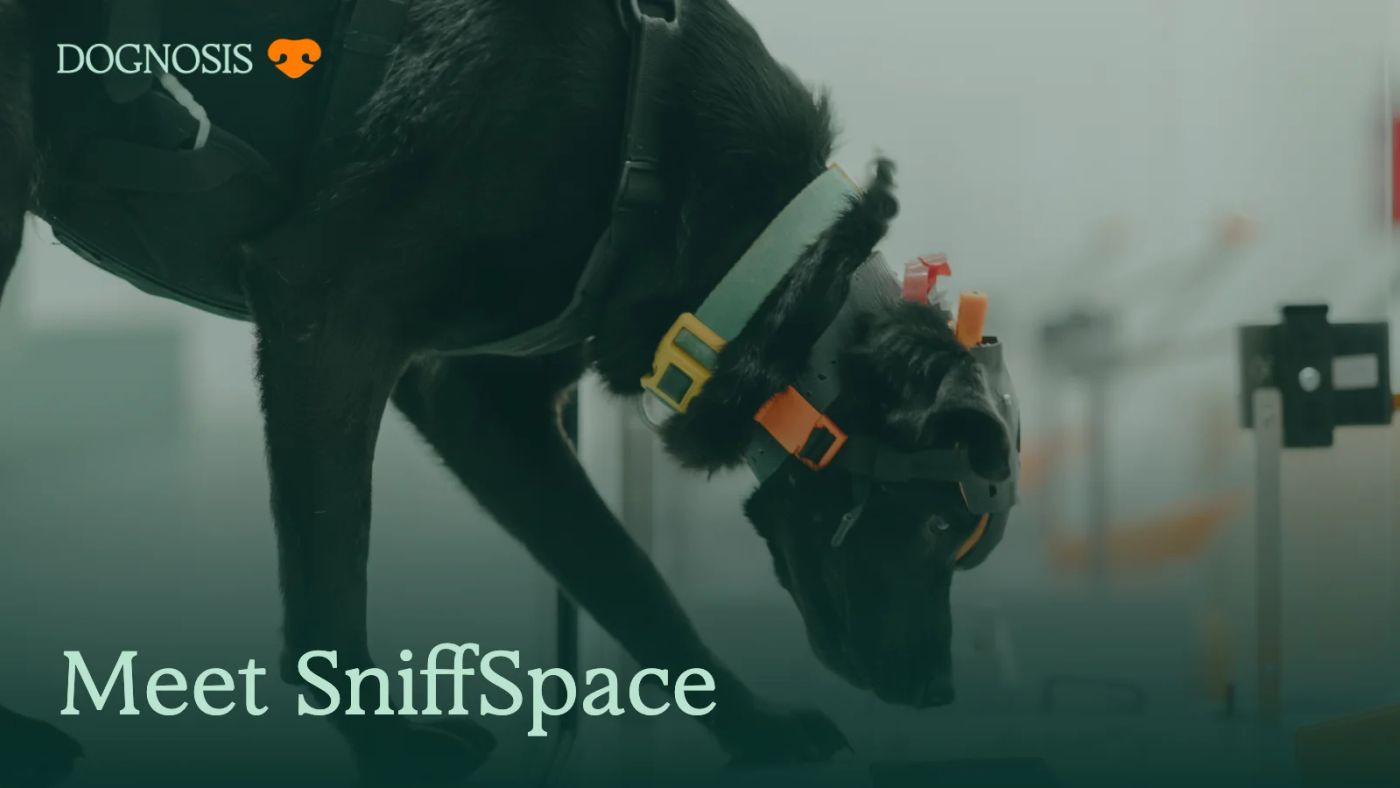
When a mask reaches our lab, it has been sealed and kept cold since the moment it was collected, with a documented chain of custody. There it's tagged and loaded onto a tray, six to a tray, and twelve trays make a session: 72 samples, set around a walking loop where a dog like Chloe moves from port to port. That loop is SniffSpace.
What Is SniffSpace?
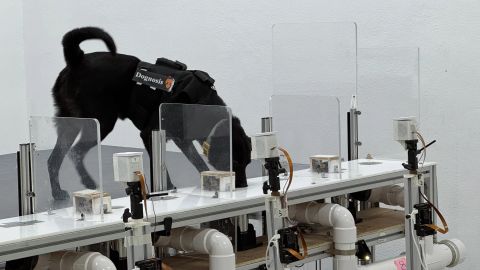
SniffSpace is the automated platform where our dogs sniff the samples sent to us for CancerWatch by Dognosis, and it records their reactions live. The dogs walk a loop with twelve ports around its edge, a feeder in the middle and side covers that keep them on the deck. The workstation in our published study had eight ports, along with synchronised video and infrared sensors and automated feeder and barrier gates (Kulgod et al., Journal of Clinical Oncology, 2026), and today's has twelve.
We built it because, as a 2020 review put it, "methods for testing canine scent detection vary" (Lazarowski et al., Frontiers in Veterinary Science, 2020). Studies differ in how they're set up, what samples they use and how the dogs are trained, and researchers have long asked for standardisation and double-blind procedures (Jezierski et al., Journal of Breath Research, 2015). Other labs have automated their presentation too: one olfactometer used computer-controlled valves to deliver scent to three ports, and dogs trained on it picked the right one with more than 95% sensitivity and specificity (Aviles-Rosa et al., PLOS One, 2024). SniffSpace applies the same idea to cancer samples, at a much larger scale.
How Does a Sample Move Through SniffSpace?
Before a session, each mask is scanned so its ID is tied to its slot, the trays are latched into their ports, the dog comes up the entry steps and a trainer starts the run. From there every sample goes through the same sequence: the tray turns it to the port and the slider opens, the platform checks its ID, the dog sniffs while a sensor detects her nose, and a camera and vision model check that it was a real sniff. Then the reward is delivered, the slider seals the sample and suction clears the port, and the tray turns to the next mask.
Because every sample is scanned and every port is logged, any result can be traced back to its sample, its tray and its port.
How Does SniffSpace Know a Dog Really Sniffed?
Sniffing is a distinct action in dogs, with its own airflow pattern, built to carry odour to the part of the nose where it's detected (Craven et al., Journal of the Royal Society Interface, 2010), and in simulations of a canine-family nose, a sniff delivered about 2.5 times more air to the olfactory region than quiet breathing (Rygg et al., Chemical Senses, 2017). A dog who walks past a port without sniffing it tells us little about the sample, so a sniff counts only when two things are true: the platform has confirmed that the right sample was presented, and the camera has confirmed that the dog actually reached the port. A tray that hasn't finished turning doesn't count either, and we tightened that rule in September.
How Are Samples Kept Apart?
Dogs can pick out some odours at concentrations as low as one part per trillion (Angle et al., Frontiers in Veterinary Science, 2016), so even a trace left behind could matter. Suction therefore works in two stages: after every sniff the port clears its own air, so one sample's scent doesn't carry over to the next, and after all 72 samples the whole cabin is cleared and vented outside.
Keeping 72 samples apart is one platform's job, and the plan is bigger: every sample is sniffed by at least three dogs, and to reach around 250,000 samples a year we plan to run several SniffSpace platforms side by side on a single campus.
Through all of it, the detecting is the dogs' own. DogSense records how they respond as they sniff and DogOS combines those responses into a Breath VOC score, and SniffSpace makes sure we always know which sample they were smelling. If you'd like to hear when CancerWatch reaches your city, the waitlist is open.
CancerWatch is not a diagnostic test. It does not diagnose, predict, prevent, cure, treat, mitigate, or monitor cancer or any other disease or disorder.