A History of Medical Detection Dogs
Every disease has a scent. Proving it and building something clinical from it has taken the better part of four decades. This is that story, including our chapter.

The History of Cancer-Sniffing Dogs
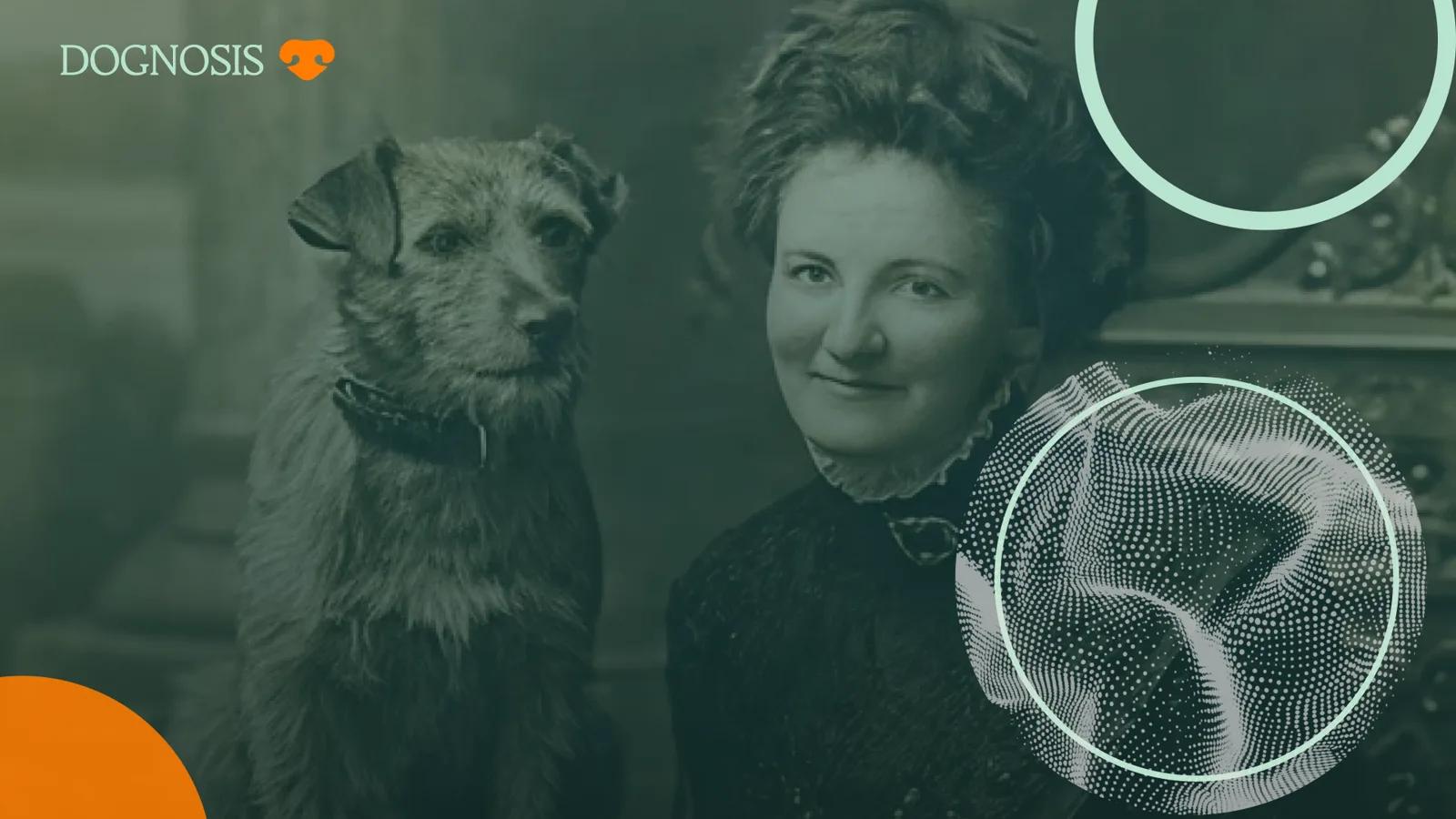
The first published account of a dog detecting disease dates back to 1989. Two London dermatologists, Hywel Williams and Andres Pembroke, described a patient whose dog would not stop sniffing at a mole on her leg, ignoring every other mark on her body but eventually trying to bite the lesion off. The attention worried her enough to see a doctor. The mole was a malignant melanoma, caught while it was still thin and curable (Williams & Pembroke, The Lancet, 1989). Their hypothesis, that tumours give off odours invisible to us and obvious to a dog, has held up remarkably well since.
Four years later, a Florida dermatologist named Armand Cognetta, frustrated that one in five melanomas went undetected, decided to test that hypothesis on purpose. Working with K-9 trainer Duane Pickel and a schnauzer named George, he built a training path that moved from melanoma samples hidden around the house, to a box of ten holes, to samples hidden under bandages on a volunteer's skin. George was then tested on seven real patients suspected of having melanoma. He got four right, maybe five, depending on how you settle the ground truth on an eyeballed diagnosis. Williams wrote about it again in 2001 (Church & Williams, The Lancet, 2001).
It took until 2004 for the field to earn a real experimental design. Six dogs were trained to pick the bladder cancer sample out of a lineup of seven urine samples, a task where chance alone succeeds about 14% of the time. They got it right on 22 of 54 attempts, a rate of 41%. Comfortably above chance, and the first properly controlled evidence that something real was happening (Willis et al., BMJ, 2004).
The dogs in every story so far, Williams and Pembroke's melanoma case, Cognetta's George, the 2004 bladder cancer study, are one specific kind, and it's worth being precise about which. Two kinds of medical dog get lumped together and shouldn't be. A biomedical detection dog identifies disease directly, either by smelling an infectious agent or by picking up on the volatilome, the mixture of volatile organic compounds a body gives off as it changes. A medical assistance dog does something else. It learns a specific person's own smell or behaviour and warns a handler before a hypoglycaemic episode or a seizure, a related instinct put to a different job. Everything from here on is about the first kind.
The Latest Research on Medical Detection Dogs
By 2021, a systematic review found dogs had been tested across at least sixteen disease types, in humans, animals, even trees, and that double-blind protocols were finally becoming the norm rather than the exception (Jendrny et al., BMC Infectious Diseases, 2021). Two organisations show how far the research itself has moved past a single case report. Medical Detection Dogs in the UK co-authored a study showing dogs could identify children carrying malaria parasites by odour alone, in asymptomatic cases where there was nothing else to go on (Guest et al., The Lancet Infectious Diseases, 2019). More recently, the same charity trained two dogs to tell Parkinson's skin swabs from controls in a double-blind trial, and both cleared 90%+ specificity (Rooney et al., Journal of Parkinson's Disease, 2025). The field has picked up mainstream press too, in the New York Times, WIRED, Nature, and The Scientist.
Then the pandemic gave the field its biggest natural experiment. A 2023 review counted twenty-seven Covid-detection studies across fifteen countries (Meller et al., Annals of Epidemiology, 2023). One of them is worth the extra sentence. A UAE study ran a Bayesian analysis pitting dogs against RT-PCR across 3,290 people, and the dogs came out ahead (Hag-Ali et al., Communications Biology, 2021). The test used to define "truth" in nearly every other study in this field lost to a dog. Most of this research still runs on a handful of dogs, typically single digits.
We've added our own chapter since first writing this piece. Our Phase II study went live in the Journal of Clinical Oncology (JCO) at the end of April 2026: 90.8% sensitivity, 91.3% specificity, an AUC of 0.962, across seven cancer groups spanning more than 20 individual cancer types, holding at Stage 1 (Kulgod et al., Journal of Clinical Oncology, 2026). JCO commissioned an exclusive editorial to accompany the paper, a distinction reserved for a small fraction of what it publishes, and invited us onto its monthly podcast to discuss it, neither of which happens by default. This is analytical validity, proof the system can tell cancer from non-cancer under controlled conditions. Clinical utility, whether running this on a real screening population produces the outcomes we believe it can, is what the next study has to show.
What Scent Tells us About Disease
Williams and Pembroke's 1989 hypothesis has since hardened into an actual mechanism. The idea itself is not new. It traces to the Hippocratic Corpus, specifically the treatise Prognostic, one of the works most widely accepted as authentically Hippocratic, which instructs physicians to read odour, among other bodily signs, to anticipate the course of a disease (Hippocrates, Prognostic, in Hippocrates, Vol. II, Harvard University Press, 1923). Not every early theory read that causality correctly, though. Miasma theory, which predominated before germ theory took over, went too far in the other direction and got the causality backwards, treating odours as the cause of disease rather than a reflection of it.
Every cell's metabolism throws off low-molecular-weight byproducts that leave the body through breath, skin, blood, and waste (Haick et al., Chemical Society Reviews, 2013). That collection is the volatilome, and it's worth its own deep dive. It shifts in disease-specific ways, and with training, a dog can learn to recognise the shift across different people.
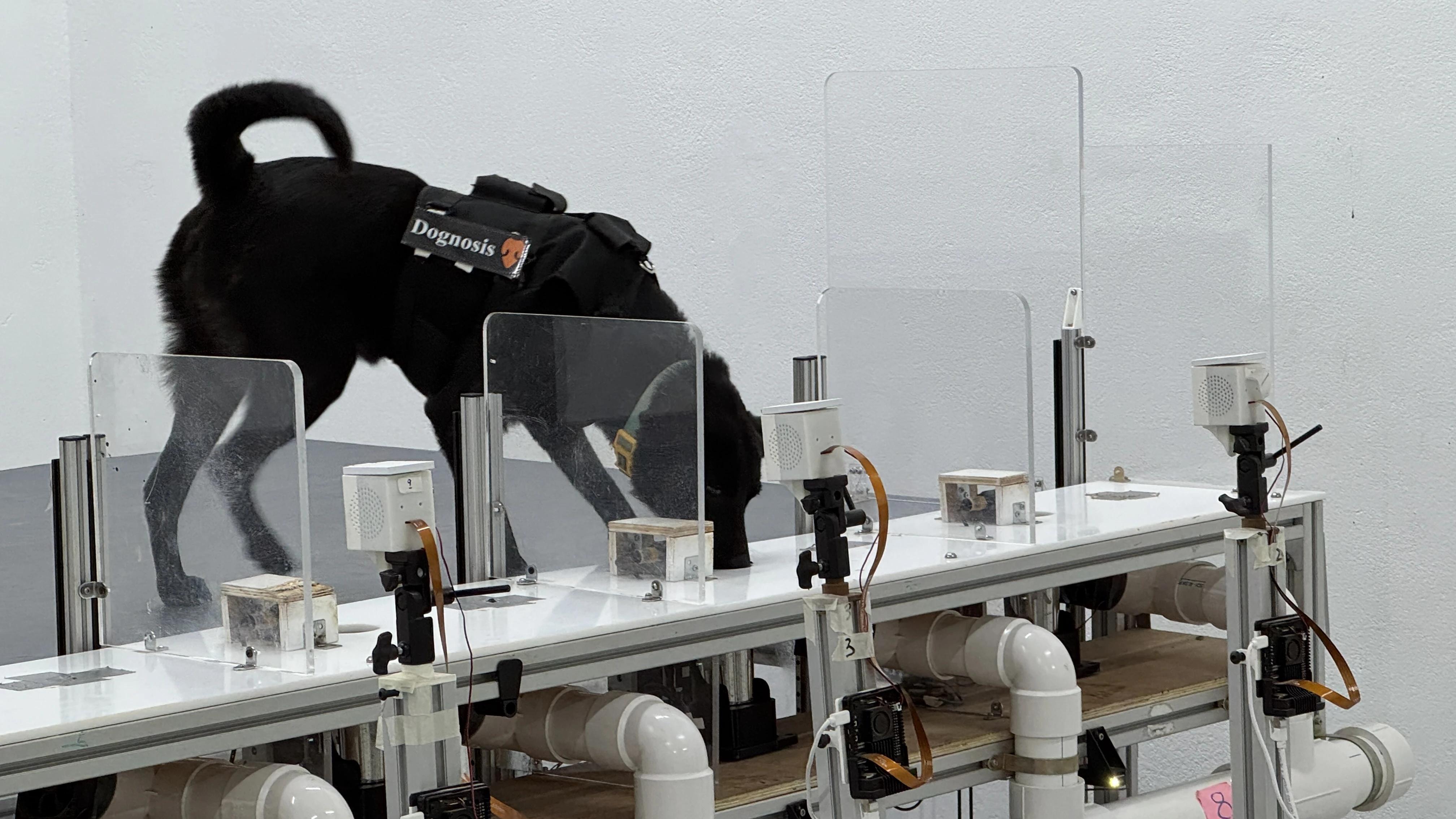
Training has moved a long way past hiding test tubes around a house. A dog signals a target scent through a stare, a sit, or a nose press against the sample container, shaped entirely through positive reinforcement.
Where The Machines Got Stuck
Once dogs proved the concept, researchers wanted a machine to replicate it. As early as 2010, a team in Israel built a nanosensor array that could tell healthy and cancerous breath apart across lung, breast, colorectal, and prostate cancer (Peng et al., British Journal of Cancer, 2010). A decade later, a study tried to train a neural network to spot prostate cancer from urine VOCs, using the same chromatography data, informed by what the dogs had already found (Guest et al., PLOS ONE, 2021). It ran into a hard limit, since no single molecule works as a clean biomarker. The signal lives in the overall scent character, a gestalt, and a chromatograph struggles to reduce that to a table of chemicals. Dogs are extremely good at reading a pattern instead of a parts list.
Why Aren't Detection Dogs Used in Medicine Yet
Medicine is essentially two problems: detection and treatment. The more interesting one, to us, is detection, because canine olfaction forces an uncomfortable question about what counts as ground truth. The UAE study above is the clearest example. The dogs beat RT-PCR, the test every other paper in this field treats as the gold standard against which dog performance gets graded. If the referee is wrong more often than the player, the scorecard needs rethinking.
Even setting that epistemological question aside, the practical obstacles to scaling this are well known: no standardised regulatory pathway, real training costs, a dog's relationship with its own handler that can't be anonymised the way a lab sample can, and the infrastructure a working dog needs to stay healthy and effective (Jendrny et al., BMC Infectious Diseases, 2021). Underneath all of that sits a harder obstacle, an instinctive discomfort with letting a dog's judgement carry weight in a life-or-death decision, even when the data says the dog is right.
The usual response has been to sidestep the carbon-based black box entirely and build a silicon one instead, on the assumption that a neural network is somehow more legible than a dog. We think there's a better path. Combine the two, so the dog does what nothing has yet matched, and the machine makes that capability consistent, auditable, and scalable. What that looks like in practice is still being worked out, with the dogs, for their part, waiting patiently.
What Comes Next
Turning that capability into something people can actually use is the next step. BreathEasy is targeting a commercial launch in early 2027, starting in Bengaluru. If you want to be first in line when it reaches your city, join the waitlist.