Galleri vs BreathEasy: What the FDA Vote and NHS Results Mean
An FDA panel backed Galleri and two large studies reported results in the same week. Here's what they show, and where breath-based detection fits alongside blood.

September brought the biggest week multi-cancer early detection has had so far. On September 23, an FDA advisory panel voted in favour of GRAIL's application to approve Galleri, its blood test for many cancers at once, and the day before, results from the test's two largest studies were published in Nature Medicine and the New England Journal of Medicine (OHSU News, 2026). For anyone deciding which tools belong in a screening programme, the new evidence is worth reading closely, both for what it shows about blood-based testing and for where breath-based detection fits alongside it.
What Did the FDA Advisory Panel Decide About Galleri?
The panel held three separate votes on the test's use in adults aged 50 and older. It was unanimous that Galleri is safe, voted 7 to 2, with one abstention, that its benefits outweigh its risks when used alongside routine screening (Oncology Nursing News, 2026), and split more narrowly, 6 to 4, on whether it is effective (Dealroom, 2026). The FDA isn't bound by its advisory panels and is expected to make a final decision in the coming months (The ASCO Post, 2026).
That narrower vote on effectiveness reflects real disagreement among experts about how to read the same trial data. If approval follows, Galleri would become the first multi-cancer early detection test approved in the US, and institutions planning their screening strategy will want to factor that into their timelines.
What Did the NHS-Galleri Trial and PATHFINDER 2 Show?
The NHS-Galleri trial enrolled more than 140,000 people aged 50 to 77 in England to test whether adding Galleri to standard NHS screening would reduce the number of cancers diagnosed at stage III or IV. That primary endpoint wasn't met. A pre-specified secondary analysis found 14% fewer stage IV diagnoses in the Galleri group, with the effect growing in later screening rounds (ASCO, 2026; GRAIL, 2026). Among the cancers the test itself detected, 39% were found at stage I or II (Nature Medicine, 2026).
PATHFINDER 2 followed 35,878 adults aged 50 and older in the US and Canada who had Galleri alongside their recommended screenings. Adding the test raised the number of cancers found through screening 6.5-fold, about seven in ten of the newly found cancers had no recommended screening test, and when Galleri flagged a cancer signal, a cancer was confirmed about 60% of the time. Its specificity was 99.6%, and it detected 39.3% of all cancers diagnosed in participants during follow-up (GRAIL, 2026; OHSU News, 2026).
Taken together, the two studies describe a test that finds real cancers, many of them with no other screening option, and that adds the most when layered onto existing screening. What they haven't yet shown is that finding those cancers earlier shifts the stage at which cancer is diagnosed across a whole population, which is the hardest thing in early detection to prove.
Why Is Early-Stage Cancer Hard to Detect in Blood?
Galleri looks for DNA that tumours shed into the bloodstream, and smaller, earlier tumours tend to shed less of it. In a study of 640 patients, circulating tumour DNA was detectable in more than three-quarters of people with many advanced cancers, and in fewer of those whose tumours were still localised (Bettegowda et al., Science Translational Medicine, 2014). Galleri's own validation study shows the same pattern: sensitivity (the share of cancers a test catches) was 16.8% at stage I and 40.4% at stage II, rising to 90.1% at stage IV (Klein et al., Annals of Oncology, 2021). That puts the most valuable part of the problem, finding cancer at its earliest stages, where the blood signal is weakest.
How Does BreathEasy Compare at Early Stages?
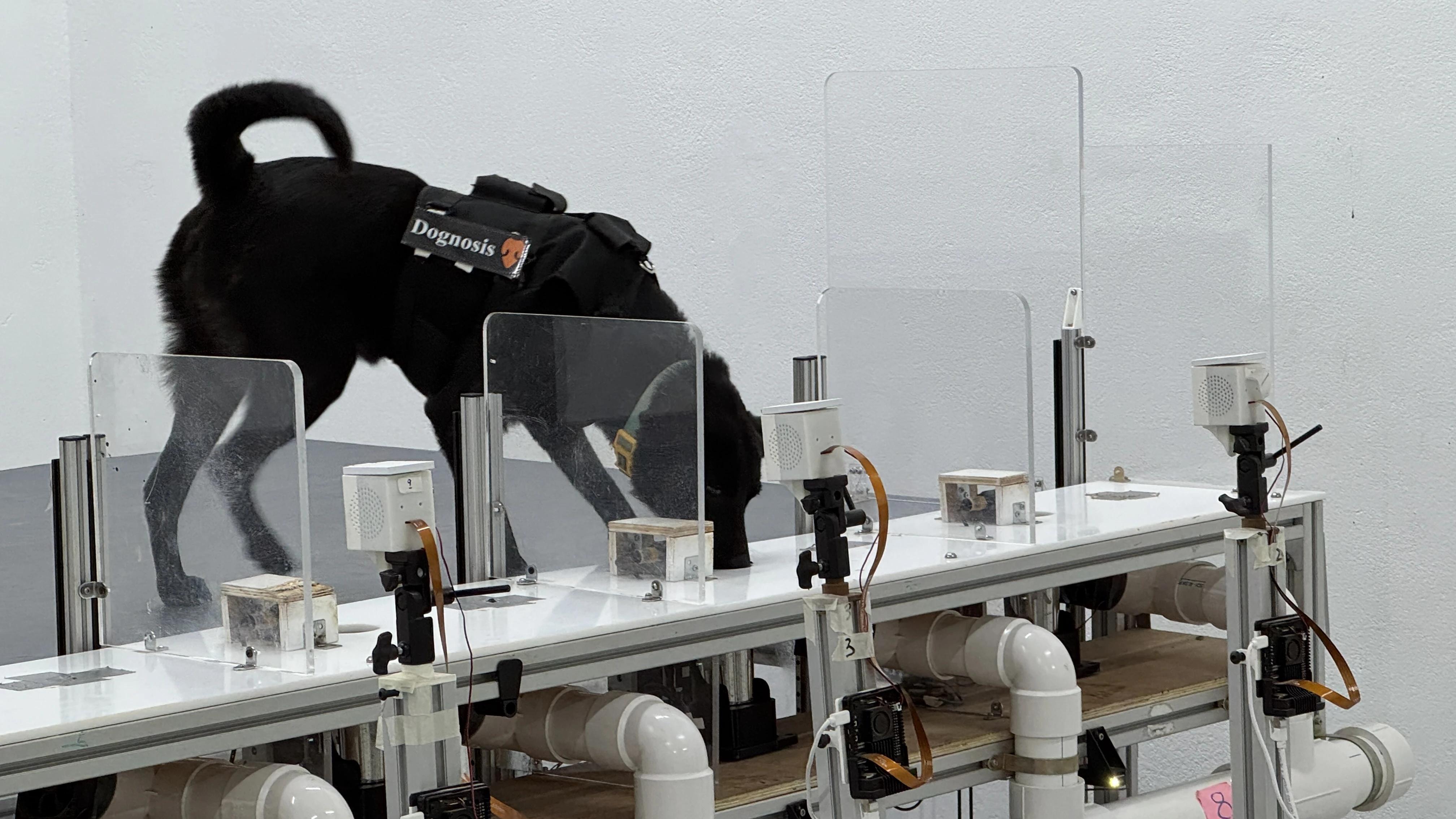
BreathEasy reads a different signal. Tumour cells metabolise differently from healthy ones, and that difference leaves a pattern of volatile organic compounds (VOCs) in the breath (Every Disease Has a Scent explains the chemistry). Trained dogs sniff breath samples on SniffSpace, our automated sniffing platform, while DogSense, a brain-computer interface fitted to each dog, records their response, and DogOS, our machine learning models, turns it into a Breath VOC score that a clinician reviews.
In our peer-reviewed study in the Journal of Clinical Oncology, BreathEasy achieved 90.8% sensitivity and 91.3% specificity (the share of people without cancer correctly cleared) in multicancer detection from breath samples of 3,275 participants, across seven cancer groups spanning more than 20 cancer types. Sensitivity held at 90.3% for stage I cancers and 90.6% for stages I and II combined. Galleri's validation study and ours were both case-control studies, which compare people already known to have cancer with people known not to, so their early-stage figures can be read side by side.
The same design also flatters performance compared with a real screening population, because cancer is far more common in a study group than in everyday life. That's why prospective data is our next step, and why we can't yet report how often an elevated score turns out to be right in practice, the figure PATHFINDER 2 was able to measure for Galleri. Galleri also looks for more than 50 cancer types and has been through large prospective trials that BreathEasy hasn't yet run. BreathEasy doesn't hold regulatory approval in any market, and we're actively engaging with regulators.
How Can Breath and Blood Tests Work Together?
PATHFINDER 2's clearest finding was that Galleri added the most when layered onto existing screening, and the same principle applies more widely, since no single test covers the whole detection problem. A breath sample at the start of the care pathway could narrow a large group of people down to the smaller number who need further testing, whether that's imaging, a blood test like Galleri, or a biopsy. We've written more about why putting tests in that order makes each one more accurate.
September's news is a reminder of how much the field has moved, and of how much is still left to prove, for every test including ours. BreathEasy is planned to launch in Bengaluru in early 2027, and if you'd like to be among the first to take it, join the waitlist.